Best Rated Mini Rice Cookers: How to Choose
The best rated mini rice cookers are 3-cup fuzzy logic models, because they adjust time and temperature for rice types and grains instead of running one fixed cycle. The Toshiba Mini 3-Cup is the pick for most buyers; the Tiger JBS-A55U suits cooks who want a heavier ceramic-coated pot.
On this page (9 sections)
- What does "best rated" mean for a mini rice cooker?
- Why 3-cup is the real size to check
- How fuzzy logic changes the result
- The inner pot is the part you touch every day
- What each mini rice cooker is best at
- How much counter space and clearance do you need?
- Cleaning and everyday care that keeps rice from sticking
- What to compare before you pick a mini rice cooker
- Which mini rice cooker should you buy?
The best rated mini rice cookers are 3-cup fuzzy logic models, because they sense moisture and adjust time and temperature instead of running one fixed cycle. The Toshiba Mini 3-Cup is the pick for most buyers, with the Tiger JBS-A55U close behind for cooks who want a heavier ceramic-coated pot.
A mini rice cooker earns its counter space when it cooks more than plain white rice. The three models below each handle 3 cups of uncooked rice, which yields about 6 cups cooked.
That is roughly 2 to 4 servings depending on appetite. If your goal is a small household rather than a general guide, start with our roundup of rice cookers for 2 people.
What does "best rated" mean for a mini rice cooker?
"Best rated" here means the model combines solid specs with the features mini-cooker buyers actually use. A long feature list with a weak pot or a hard-to-clean lid matters less than a simple cooker that gets the basics right.
We compared the three picks on five things: real cooked capacity, control type, inner pot material, keep-warm duration and how easy each lid is to remove for washing.
The Toshiba leads at 8.6. It pairs 8 cooking functions with a non-stick inner pot and a 24-hour delay timer.
The Tiger JBS-A55U sits at 7.2 on the strength of its 3.0 mm ceramic-coated pot and 10 settings. The Amazon Basics lands at 7.1 as the lowest-cost fuzzy logic option in this group.
A high score should match your cooking, not just the feature count. A cooker with 10 grain settings is wasted on someone who only steams jasmine rice.
Decide your rice types first, then look at the control type and pot that support them.
The 8.6 score: why the Toshiba leads
The Toshiba Mini 3-Cup wins on breadth. Toshiba says its fuzzy logic system senses moisture and adjusts temperature and cooking time accordingly.
That matters most when you switch between white rice, brown rice, mixed grain and porridge in the same week.
The 8.6 score reflects that range plus the delay timer, which lets you set a meal hours ahead. The 460-watt element is modest, as you would expect in a mini cooker.
Its delay timer goes beyond the 12-hour keep-warm window on the Tiger.
Why 3-cup is the real size to check
The 3-cup figure refers to uncooked rice, and that cooks into about 6 cups of finished rice. Reading it as 3 cups of cooked rice is the most common buying mistake with mini cookers.
All three models follow the same convention. The Toshiba holds 3 cups uncooked for 1 to 3 people.
The Amazon Basics and Tiger both state 3 cups uncooked, with the Tiger adding that this yields about 6 cups cooked.
That is enough for two generous rice bowls with leftovers for lunch. It is not enough for a family of four eating rice as the main starch, so size up to a 5- or 6-cup cabinet if rice anchors most meals.
You also outgrow the mini size quickly if you batch-cook rice for the week.
Grains expand more than rice. Mixed grain and oatmeal loads can foam and rise more than white rice, so keep them below the marked line for those settings.
For portion size, plan 1/2 cup of uncooked rice per adult for a full rice bowl.
When a 3-cup mini cooker is the wrong buy
Skip the 3-cup size if rice is the main starch for three or more people at dinner. A 5- or 6-cup cooker gives you headroom without a much bigger footprint.
If your main goal is cheap rice with no fuss, a rice cooker under 100 will cover plain white rice without paying for fuzzy logic. Compare that route against these models before you commit.
How fuzzy logic changes the result
Fuzzy logic adjusts cooking time and temperature as the rice cooks, while a basic cooker runs one timed cycle. That difference shows up most on brown rice, mixed grain and porridge.
Toshiba's system senses moisture in the pot. It then adjusts temperature and cooking time to match, so you don't manually tweak a timer for each rice type.
The Amazon Basics model uses the same approach, with a menu of 8 settings.
The Tiger uses Micom control. It adjusts cooking length and temperature, and also adjusts soaking and steam times to suit the rice.
Micom and fuzzy logic are close cousins here: both replace the fixed timer with a controller that responds to the load.
What fuzzy logic gives you in practice: better brown rice, because soaking and longer controlled heat are what brown rice needs. More forgiving batches when your water ratio is slightly off.
And grain settings beyond rice, since oatmeal, mixed grain and porridge all benefit from time and temperature control.
The trade-off is cost and complexity. A fuzzy logic mini cooker costs more than a one-touch model, and its panel has more buttons.
If you eat only white rice and set a timer with your phone, the cheaper basic cooker is fine.
Quick cook, keep warm and delay timers
The quick cook function shortens the cycle when you need rice fast. It works for white rice on a rushed evening, though it is not a substitute for soaking brown rice.
Keep warm holds cooked rice above room temperature so it stays usable. The Tiger holds warm for up to 12 hours.
The Toshiba lists auto keep warm and a reheat function. Reheat is worth looking for, because it warms cooled rice without another full cycle.
The delay timer schedules cooking up to 24 hours ahead. It suits anyone who wants rice ready when they walk in from work.
Remember that raw rice sitting in water all day is a food-safety question you should handle with care.
The inner pot is the part you touch every day
The inner pot decides how well rice releases, how easy cleanup is and how long the surface lasts. All three use non-stick coatings, and the Tiger goes further with a ceramic-coated 3.0 mm pot.
The Toshiba pot has a non-stick coating and should be hand washed with mild soap and a soft cloth. Its maker advises against the dishwasher.
The steam valve on the lid and the steam vent cap both come off, which makes the top end easier to clean.
The Tiger's inner pot is 3.0 mm thick with a ceramic coating. Tiger describes it as non-PFAS and scratch resistant, with measurement markings for different rice types.
The extra thickness helps hold heat and resists warping over time.
The Amazon Basics pot is aluminum with a ceramic non-stick coating. It is also hand wash only.
Ceramic coatings often release rice more easily than older non-stick surfaces, though they still need a soft sponge rather than steel wool.
Treat the coating as the wearable part. Metal spoons and abrasive scrubbers shorten any pot's life.
Use the plastic spatula that comes in the box.
The Toshiba includes a measuring cup, rice spatula and soup ladle. The Amazon Basics includes a measuring cup and rice scoop.
The Tiger includes a spatula and a measuring cup.
Pot material and coating in one table
| Model | Pot material | Coating | Washing |
|---|---|---|---|
| Toshiba Mini 3-Cup | Non-stick inner pot | Non-stick | Hand wash, mild soap |
| Tiger JBS-A55U | 3.0 mm ceramic-coated | Ceramic, non-PFAS | Hand wash |
| Amazon Basics 3-Cup | Aluminum | Ceramic non-stick | Hand wash, mild soap |
The comparison matters because a coated pot you scrub in the sink is the part that wears first. A thicker pot like the Tiger's also holds heat longer after the cycle ends.
Our guide to rice cookers for jasmine rice goes deeper on how pot and setting affect sticky rice.
What each mini rice cooker is best at
Each of the three models suits a different cook. The Toshiba covers the widest range of rice and dishes.
The Tiger leans on its heavy pot and grain settings. The Amazon Basics keeps fuzzy logic at the lowest cost.
Toshiba Mini 3-Cup: the all-rounder for small households
Toshiba Mini 3-Cup Fuzzy Logic Rice Cooker

The Toshiba is the one to buy if you want a single mini cooker for rice and simple dishes. It has 8 functions: white rice, quick cook, brown rice, mixed grain, slow cook, porridge, cake and egg.
Toshiba also lists soups and stews among its uses.
Its fuzzy logic handles jasmine, sushi, basmati and wild rice as well as oatmeal and quinoa. A 24-hour delay timer and keep warm cover the timing side.
The cabinet measures 11.6 in wide by 9 in deep by 8 in high and weighs about 3 kg. The hand wash only pot and the 460-watt element are the main compromises, and neither is unusual for this size.
Tiger JBS-A55U: the ceramic-coated pot upgrade
Tiger JBS-A55U 3-Cup Micom Rice Cooker

The Tiger suits cooks who care most about the pot. Its 3.0 mm ceramic-coated inner pot is thicker than the pots in most mini cookers, with non-PFAS claims and measurement markings for multiple rice types.
It has 10 automated settings, including plain rice, quick cooking, steam, mixed, multigrain, slow cook, porridge, brown rice and sweet. Keep warm runs up to 12 hours.
The detachable steam cap and inner lid make cleaning simpler.
Tiger says the cooker is made in Japan and UL certified for 120V power. Its footprint runs larger than the Toshiba's, at roughly 10.94 in deep by 9.72 in wide by 7.56 in high.
Pick it for the heavier pot and sweet-rice setting; skip it if you need the longer delay timer.
Amazon Basics 3-Cup: fuzzy logic at the budget end
Amazon Basics 3-Cup Micom Rice Cooker
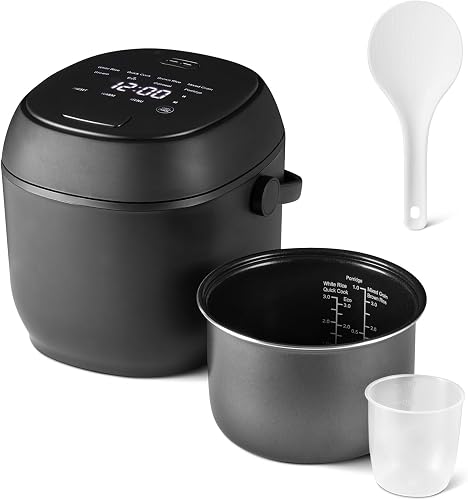
The Amazon Basics is the budget route into fuzzy logic. It runs 8 menu modes: white rice, quick cook, brown rice, mixed grain, steam, eco, oatmeal and porridge.
The 450-watt element and 3-cup uncooked capacity match the others.
Its pot is aluminum with a ceramic non-stick coating and hand wash care. A 24-hour preset and auto keep warm cover scheduling.
The locking lid, detachable cord, thermal fuse and steam vent cap all target safety.
It is smaller in footprint than the Toshiba, at 9.37 in deep by 7.67 in wide by 7.87 in high, and lighter at 1.8 kg. Pick it if budget matters more than a thick pot.
Skip it if you want a broader function list or a delay timer you trust for long pre-soaks.
How much counter space and clearance do you need?
Measure the cabinet plus the vent clearance before you buy, because a mini cooker still needs breathing room. The footprint is only part of the answer.
The Toshiba has the widest footprint at 11.6 in. The Amazon Basics is the smallest of the three at 7.67 in wide and 9.37 in deep.
The Tiger measures about 11.06 in deep by 12.87 in wide by 8.9 in high, making it the widest of the three.
Then add space for the steam vent. All three release steam through the lid during cooking.
Leave clearance above and around the vent so steam doesn't hit a cabinet underside. Check the manual for the exact gap your model needs.
A few practical checks. Leave standing room in front to lift the lid and reach in with a spatula.
All three are corded electric, so confirm your outlet position and that the detachable cord won't stretch across a walkway. If the cooker goes under a cabinet, make sure the open lid won't hit the shelf above.
Measure twice with a tape and a piece of painter's tape on the counter. A cooker that fits the cabinet but not the vent clearance is still the wrong fit.
Cleaning and everyday care that keeps rice from sticking
Clean the pot and removable parts by hand after each use, and the coating stays useful for longer. Rice left to dry in the pot is the main cause of scrubbing.
The routine is short. Let the pot cool, then fill it with warm water and mild soap.
Use a soft cloth or sponge on the non-stick or ceramic surface and never use steel wool. Remove the steam valve and steam vent cap from the lid on the Toshiba; the Tiger's steam cap and inner lid both detach.
Dry the pot fully before storing it, and wipe the outer body and heating plate with a damp cloth rather than dunking the base in water.
All three models are hand wash only. None of the product data lists a dishwasher-safe pot.
Treat that as the norm for coated mini cookers.
A few habits keep rice from sticking in the first place. Rinse the rice before cooking, level it in the pot and use the measuring cup that came with the cooker.
Don't overfill beyond the line for your chosen setting. Grains like mixed grain and oatmeal foam more than white rice.
Do you need to rinse rice for a mini cooker?
Rinsing removes loose surface starch and helps rice cook into separate grains. It matters most for jasmine and sushi rice.
Give the rice two or three changes of water until it runs mostly clear. Skip the rinse only when the setting and recipe call for unrinsed rice, like some porridge styles.
What to compare before you pick a mini rice cooker
Compare five things before you buy: cooked capacity, control type, inner pot, keep-warm duration and cleaning. That short list separates the three models here better than a long feature table.
Capacity. All three hold 3 cups uncooked.
Two people eating rice as a side fit easily.
Four people eating rice as the base of the meal should look at a larger cabinet.
Control type. Fuzzy logic or Micom control both beat a one-touch timer for anything beyond white rice.
The Toshiba and Amazon Basics use fuzzy logic; the Tiger uses Micom control with adjustable soak and steam times.
All three are a step above a basic switch.
Inner pot. Coating type and thickness decide how the rice releases and how long the pot lasts.
The Tiger's 3.0 mm ceramic pot is the thickest here.
The Toshiba and Amazon Basics use non-stick or ceramic non-stick coatings.
Keep warm and timers. The Tiger holds warm for up to 12 hours.
The Toshiba lists keep warm and reheat plus a 24-hour delay.
The Amazon Basics lists auto keep warm and a 24-hour preset. Pick based on when you actually eat.
Cleaning. All three are hand wash only.
The removable steam parts matter more than the outer body.
A lid you can strip down cleans faster.
If your shortlist is still wide, our ranking of the customer rated most reliable rice cooker looks at which models hold up over time. The comparison here focuses on specs for small kitchens.
Plain white rice vs mixed grains
A one-touch cooker handles plain white rice well. It runs a set cycle and stops.
The gap opens when you add brown rice, mixed grain, oatmeal or porridge. Those need soaking, longer heat or a gentler finish.
All three picks here include brown rice and mixed grain modes. The Toshiba adds cake and egg settings.
The Tiger adds sweet rice. The Amazon Basics adds steam and eco modes.
Pick the function list that matches the dishes you actually cook.
Which mini rice cooker should you buy?
Buy the Toshiba Mini 3-Cup for most people. It has the widest function list of the three, a 24-hour delay timer, keep warm and reheat, and a footprint that fits a small kitchen.
Its 8.6 score is the highest here.
Pick the Tiger JBS-A55U instead if the inner pot is your priority. Its 3.0 mm ceramic-coated pot is thicker and rated non-PFAS.
It also has 10 settings and up to 12 hours of keep warm. The trade-off is a larger footprint and no 24-hour delay timer.
Choose the Amazon Basics 3-Cup if you want fuzzy logic at the lowest cost. It covers 8 modes and includes a 24-hour preset.
Its smaller footprint and lighter 1.8 kg weight suit a tight counter.
The best rated mini rice cooker for you comes down to three questions. Do you cook grains beyond white rice?
Do you want a timer you can set a day ahead? How much counter width can you spare?
Answer those and the choice is straightforward.
If you are buying for two people and rice is a side dish, the Toshiba covers it. For sticky rice as the main event, read our rice cooker for jasmine rice guide before you settle.
And if plain white rice is all you need, the rice cooker under 100 route keeps the spend low.
Frequently asked questions
What does 3-cup mean on a mini rice cooker?
It usually means 3 cups of uncooked rice, which cooks into about 6 cups of finished rice. That is roughly 2 to 4 servings depending on appetite and what you serve alongside.
Is fuzzy logic worth it in a mini rice cooker?
Fuzzy logic is worth it when you cook more than plain white rice. It senses moisture and adjusts time and temperature, so brown rice, mixed grain and porridge settings work better than a fixed one-touch timer.
Which mini rice cooker is best for one or two people?
Pick the Toshiba Mini 3-Cup for most small households. Its 8 functions cover white rice, quick cook, brown rice, mixed grain, slow cook, porridge, cake and egg, so one appliance handles breakfast through dinner.
Can a mini rice cooker handle brown rice or oatmeal?
Only models with the matching settings. All three picks here include a brown rice mode, and the Toshiba and Amazon Basics models also list mixed grain or oatmeal settings.
Check the function list before you buy.
How much counter space does a mini rice cooker take?
The Toshiba measures 11.6 in wide by 9 in deep by 8 in high. Allow extra clearance around the vent, and measure your cabinet clearance before you commit to a spot.


